Graham Sutherland, OM (1903-1980)

Sutherland was an English artist, notable for his work in glass, fabrics, prints and portraiture. His work was much inspired by landscape and religion, and he designed the tapestry for the re-built Coventry Cathedral.

Prints of romantic landscapes dominated Sutherland’s work during the 1920’s. He developed his art by working in watercolours before moving on to using oils in the 1940’s. It is these oils, often of surreal, organic landscapes of the Welsh coast, that secured his reputation as a leading modern artist in Britian. He taught at a number of art colleges including Chelsea School of Art and Goldsmiths College, where he had been a student.

Between 1940-45, Sutherland was employed as official war artist. He recorded bomb damage in rural and urban Wales towards the end of 1940 and then bomb damage caused by the Blitz in the City and East End of London. Sutherland returned to Wales in 1941 to work on a series of paintings of blast furnaces. From June 1942 he painted further industrial scenes, first at tin mines in Cornwall, then at a limestone quarry in Derbyshire and then at open-cast and underground coal mines in South Wales. In 1944 Sutherland spent 4 months at the Royal Ordnance Factory at Woolwich Arsenal working on a series of five paintings for WAAC. In December 1944 he was sent to depict the damage inflicted by the RAF on railway yards at Trappes and at flying bomb sites at Saint-Leu-d’Esserent in France.

He was commissioned to design an enormous tapestry in the new Coventry Cathedral. He also  completed a number of controversial portraits. Sir Winston Churchill famously hated Sutherland’s depiction of him and publicly humiliated him when the painting was unveiled. In 1955 Sutherland and his wife bought a house in Nice and living abroad led to a slight decline in his status in Britain. However, following a trip to Pembrokshire in 1967, his creativity was renewed and that went some way to restoring his reputation as a leading British artist.
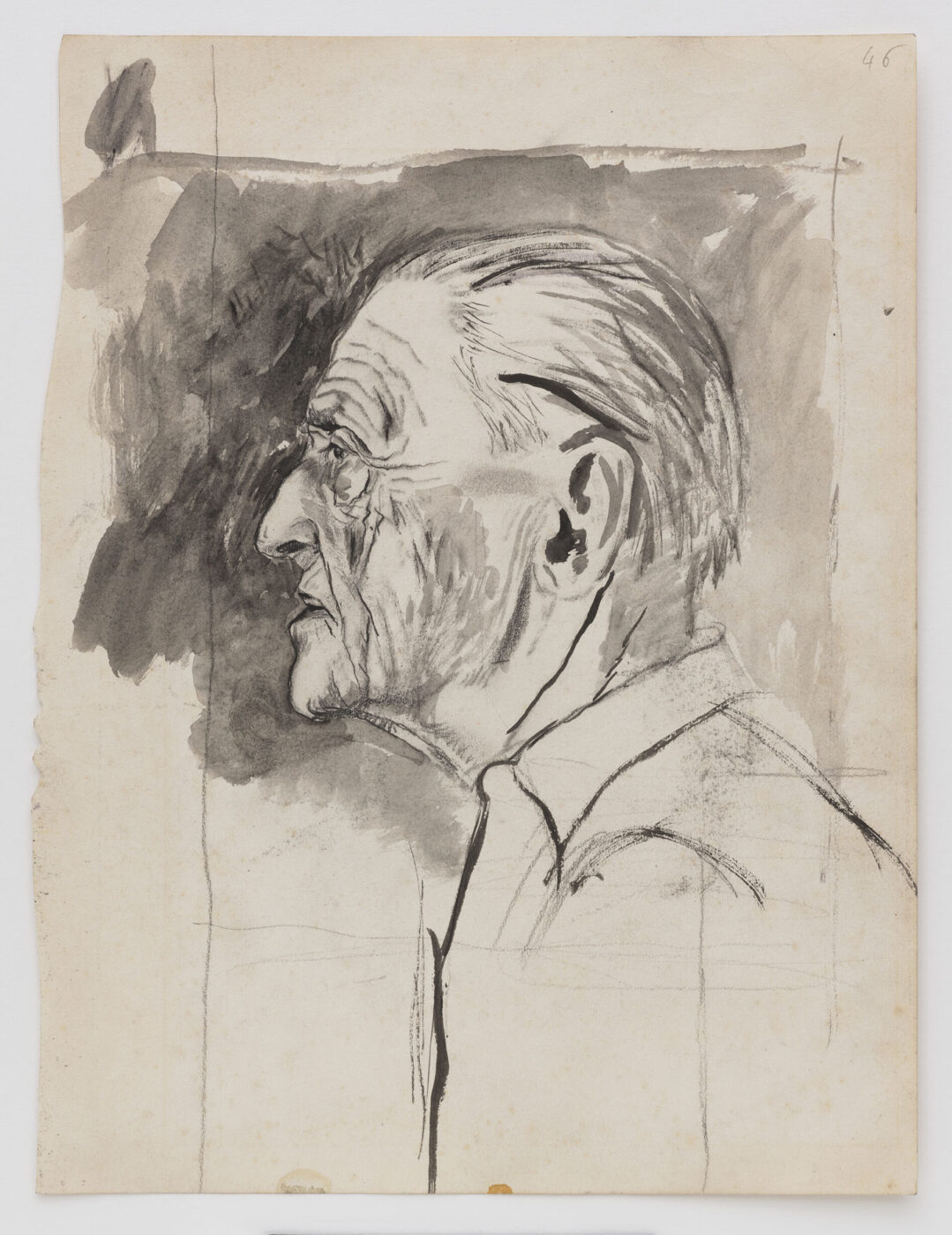
 

Graham Sutherland, OM (1903-1980), Somerset Maugham in Profile, 1949


£ click for price and more information

Pencil and ink on paper
12 ¼ x 9 ¼ in (32 x 24 cm)
Verso: Drawing of shoes

Collections: Pier Paolo and Marzia Ruggerini, Milan and thence by direct descent
Exhibited: Genoa, Museo dell’ Accademia Ligustica di Belle Arti Graham Sutherland Storia Segreta 1991 (133-repr); Varese, Museo Civici Sutherland L’Atelier dei Ritratti 1992 (p.22); Conegliano, Palazzo Sarcinelli Sutherland Ritratti 1996 (94 – repr)

Maugham and Sutherland were neighbours in the South of France. Sutherland mentioned that were he a portraitist Maugham was the sort of man that he would like to paint. This was communicated to Maugham who agreed and sat for the artist for 10 sittings in February 1949. Maugham subsequently sat again for Sutherland in 1952 for a lithograph portrait - the study of the sitter’s shoes on the verso of this drawing suggests that the present drawing relates to the earlier project.
The finished portrait, now in the collection of Tate Britain, is one of the best-known and most celebrated portraits of the 20 th Century. Douglas Cooper writing in his monograph on the artist explains that ‘’ a new vein of inspiration opened up for Sutherland when he began to see in the lines, forms and convolutions of a human face the same sort of expression of the process of growth and struggle as he found in the rugged surfaces and irregular contours of a boulder or a range of hills’’.
This drawing was part of the group bought by Pier Paolo and Marzia Ruggerini at the time of the exhibition of Sutherland’s war-time drawings organised by the British Council in Milan in 1979. The Ruggerinis first met Sutherland in 1965. Pier Paolo was a celebrated Italian film maker and in 1967 his documentary on the artist led Sutherland to return to Wales to paint there for the first time in twenty years. The Ruggerinis became great friends and collectors of Sutherland. Their house, Il Castello in Pavia near Milan, had a famous collection of the artist’s work.

Back to Graham Sutherland, OM (1903-1980)